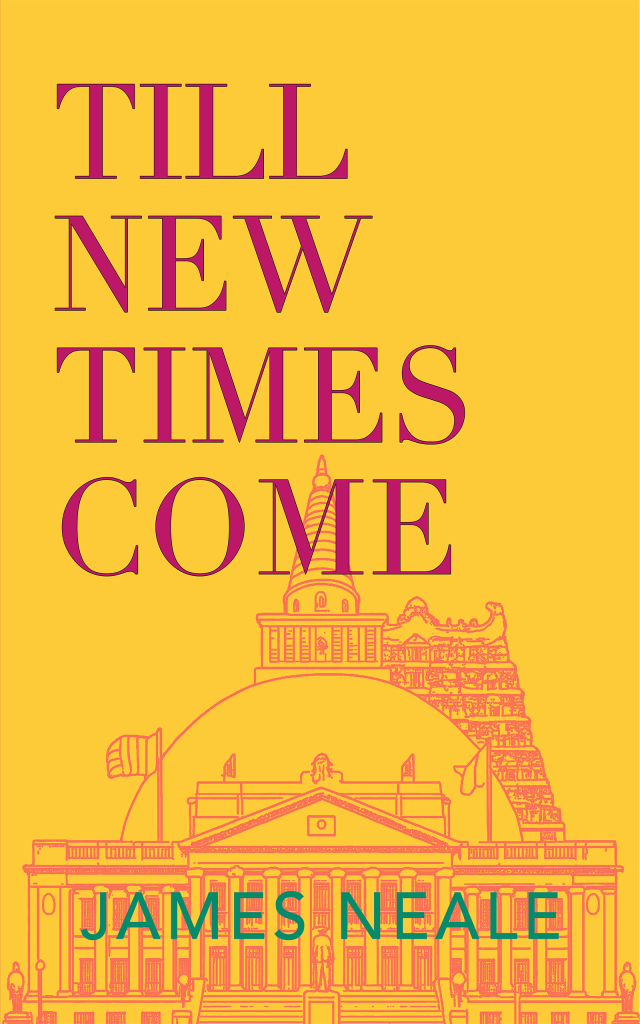
How do you tell the story of a political life—and something of a country’s history—through a single day? In Till the New Times Come, I approached S.W.R.D. Bandaranaike through the hours between his shooting and his death, when the demands of office gave way to memory, uncertainty and unfinished business.

I was born in Sri Lanka, then Ceylon, in 1954. I left as a child and have returned on several occasions. Writing about the country has meant approaching a place to which I belong, while recognising how much there is to understand.
Bandaranaike offered a particularly compelling subject. His life brought together questions of language, religion, education, belonging and political ambition. He helped shape the country’s direction, yet his own career contained striking changes of direction. His assassination gave that life a violent ending while leaving many of its questions unresolved.
The challenge was finding a form in which to explore them.
A life approached through its ending
A conventional account might begin with Bandaranaike’s childhood, follow him through school and Oxford, and trace his progress towards the premiership. That would provide a clear chronology. For this novel, however, I wanted a more immediate point of entry.
I chose his final twenty-four hours.
The hospital setting places a powerful man in circumstances he cannot command. Other people decide when he can speak, when he should rest and what must be done to keep him alive. His body imposes limits that political argument cannot overcome.
That situation creates room for a different kind of encounter with a public figure. The speeches and offices remain part of him, but so do the schoolboy, the husband, the father and the young man who once imagined a future very different from the one he lived.
The question becomes what might return to someone in those circumstances: which people, which decisions, which disappointments.
The contradictions that interested me
Bandaranaike’s contradictions are central to the novel. His English education and Oxford experience sit alongside his identification with Sinhala nationalism. His relationship with Buddhism has both personal and political dimensions. His pursuit of power is followed by the difficulty of governing the forces that helped him attain it.
Those tensions gave me something to work with beyond the familiar outline of a political career.
A person can believe in reform and still make damaging choices. He can recognise the need for compromise and fail to defend it. He can understand an argument intellectually without fully appreciating what his decisions mean for those whose lives are affected.
Fiction allows these possibilities to be explored through particular encounters. A conversation can reveal an evasion, an attachment or a moment of recognition. What interests me is the movement between a person’s account of himself and the questions that account leaves unanswered.
Why conversations matter
Much of the novel develops through dialogue, memory and imagined encounters.
The people who appear bring different parts of Bandaranaike’s life into view. A former headmaster belongs to the world of education and early expectations. His wife brings the intimacy of a shared life. Political and religious figures return him to alliances, loyalties and the exercise of authority.
Each relationship changes the conversation. Someone accustomed to addressing a crowd speaks differently to a person who knew him before he held office. A question from a wife carries a different weight from the same question asked by an opponent.
These shifts matter because public lives are often remembered through their most visible moments. Private relationships suggest other measures of a life: promises kept or neglected, habits of affection, the distance between what someone intended and what others experienced.
Within the hospital’s narrow span of time, those different measures can exist beside one another.
Making room for the future
The novel also moves beyond the boundaries of Bandaranaike’s lifetime, bringing him into imagined encounters with the island’s later history.
He could not have known that future. The reader, however, comes to his story with knowledge of what followed. I wanted the form of the novel to make something of that unequal knowledge.
This creates a difficult encounter between intention and consequence. What would a political leader recognise in a future shaped partly by decisions made during his time? What would surprise him? What might he resist accepting?
The later history does not provide a simple verdict on every earlier choice. Other people acted, other opportunities arose, and further decisions changed the country’s course. But bringing these periods together allows the novel to ask how responsibility extends beyond the moment in which a decision is made.
The fuller discussion of those imagined encounters belongs to the final article in this series. Here, their importance is that they make the hospital room a place where the past and the future can meet.
Research and the limits of imagination
Writing about a real person requires attention to what is known and care about what is invented.
The historical record provides the framework: events, relationships, political arguments and the circumstances surrounding the assassination. The novel’s private thoughts and imagined conversations belong to fiction.
That distinction matters. An invented exchange should not acquire the authority of a documented statement merely because its participants once lived. At the same time, fiction needs the freedom to explore what the record cannot supply: the experience of hesitation, pain, affection or self-deception.
For me, the work lies in keeping the historical circumstances firmly in view while allowing the characters to speak and respond as people.
An unfinished life
The attraction of those final hours was their uncertainty.
The reader knows the outcome. Within the story, there is still treatment, waiting, exhaustion and the possibility of recovery. The future has not yet become an obituary.
That gap allows the novel to remain close to the person whose life is ending. His past may be available for examination, but it has not become settled history to him. There are still things to explain, people to answer and hopes he has not surrendered.
I wrote Till the New Times Come to explore that unfinished state: a man confronting his life while the country he helped shape moves towards a future he will never see.
recent POSTS
Explore the history behind Till the New Times Come
- Why Was S.W.R.D. Bandaranaike Assassinated?
- From Oxford to Sinhala Nationalism: The Contradictions of S.W.R.D. Bandaranaike
- The Buddhist Monk Who Assassinated a Prime Minister
- The Sinhala Only Act of 1956
- Could Bandaranaike Have Prevented Sri Lanka’s Civil War?
- The Bandaranaike–Chelvanayakam Pact: A Missed Opportunity?
- Why I Wrote a Novel About Bandaranaike’s Final Twenty-Four Hours
- History and Imagination: Writing the Future into Bandaranaike’s Final Hours
- Why Till the New Times Come Takes Its Title from a Poem