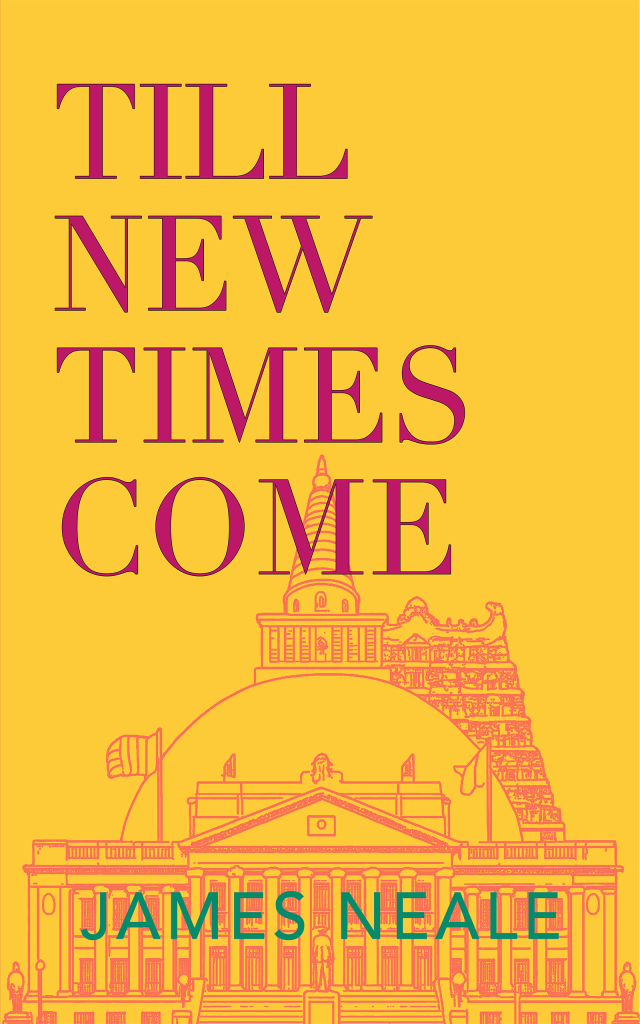
An enchanted tree, fruit that cannot yet be tasted, and a promise shadowed by loss: Andrew Lang’s ‘The Song of the Western Fairies’ offers a way into the hopes and contradictions of S.W.R.D. Bandaranaike—and the novel that imagines his final hours.

The title Till the New Times Come draws on a poem associated with Bandaranaike himself. In ‘The Song of the Western Fairies’, figures dance around a tree bearing golden apples. The fruit is there, visible and desirable, but the time to taste it has not arrived.
At the heart of the poem lies a promise:
There is none may taste of the golden fruit
Till the golden new time come
For a political leader speaking about the possibility of a new society, these lines offered a compelling image. The better world could be imagined. Bringing it within reach was another matter.
Bandaranaike and the poem
Bandaranaike brought these verses into his public life. A recollection published in The Island, ‘Working at Rosmead Place’, describes him quoting the central stanza at a University of Peradeniya convocation in 1957. The writer remembered both the beauty of the passage and its appropriateness to a speech about new times.
That recollection establishes his use of the poem. His precise reasons for choosing it require interpretation. Yet it is easy to see how its combination of hope, patience and sacrifice could speak to a politician promising national renewal.
A convocation was an especially fitting setting. The young people listening were preparing to enter a changing country. The poem placed their immediate expectations within a longer view: some achievements would take time, and those who worked towards them might never enjoy their fulfilment.
The golden fruit
The poem appears within ‘The Terrible Head’, a retelling of the Perseus story in Andrew Lang’s The Blue Fairy Book. The hero encounters three fairies dancing around a golden apple tree. Their task is to guard it until the new times come—or until the world ends.
The golden fruit can be read as an image of fulfilment: something precious that exists as a possibility but remains beyond present possession. In a political reading, it might stand for freedom made meaningful, greater dignity, or a society in which prosperity and opportunity are more widely shared.
The poem leaves that promise undefined. Its power comes partly from allowing each reader to imagine what the fruit might mean.
For the Bandaranaike portrayed in Till the New Times Come, it becomes an image of the country he hopes to help create—and of the distance between that hope and what political action actually produces.
The losses before the new times
The middle stanza gives the poem its emotional weight:
Many a tree shall spring from shoot,
Many a blossom be withered at root,
Many a song be dumb;
Broken and still shall be many a lute
Or ever the new times come!
These are unsettling lines. Growth continues, but so does destruction. Blossoms fail before they can bear fruit. Songs fall silent. Instruments that once made music are broken.
Read alongside Bandaranaike’s story, the passage raises a difficult question: how should a leader judge the suffering that accompanies the changes he hopes to bring about?
Patience may be necessary for reform. But appeals to a better future can also make present suffering easier to excuse. The poem does not resolve that tension. It holds the promise and the losses together.
That is central to the novel’s treatment of its subject. Bandaranaike’s hopes deserve to be understood, while his decisions and their consequences remain open to scrutiny. His aspirations cannot, by themselves, settle the judgement on his premiership.
Why the title fits the novel
Till the New Times Come imagines a man confronting the limits of his own time. As Bandaranaike lies dying, the future continues beyond his reach. He can remember, question and hope, but he can no longer direct what follows.
The title brings that separation into focus. A leader may help set change in motion without living to see its outcome. He may believe he recognises the shape of the future and still misunderstand the forces he has released.
The word till carries a particular poignancy. It suggests waiting for a moment of fulfilment. Yet the poem offers no date for its arrival, and the circling dance gives no certainty that the dancers are getting closer.
The novel’s title draws on the poem’s language rather than reproducing a complete line. It preserves that unresolved expectation: the new times remain ahead, desired but unseen.
A promise left open
The final stanza returns to the dance. Seasons turn, stories are told, and the world continues to spin. Individual lives occupy only a brief part of that movement.
For a novel centred on a dying prime minister, this is a powerful perspective. Political authority can appear immense, yet it cannot secure a person’s legacy or determine how later generations will understand his actions.
Till the New Times Come therefore carries both hope and sorrow. It evokes the possibility of a better country, the lives spent pursuing it, and the uncertainty of whether the promised fruit will ever be shared.
The man’s time is ending. The country’s story continues.
recent POSTS
Explore the history behind Till the New Times Come
- Why Was S.W.R.D. Bandaranaike Assassinated?
- From Oxford to Sinhala Nationalism: The Contradictions of S.W.R.D. Bandaranaike
- The Buddhist Monk Who Assassinated a Prime Minister
- The Sinhala Only Act of 1956
- Could Bandaranaike Have Prevented Sri Lanka’s Civil War?
- The Bandaranaike–Chelvanayakam Pact: A Missed Opportunity?
- Why I Wrote a Novel About Bandaranaike’s Final Twenty-Four Hours
- History and Imagination: Writing the Future into Bandaranaike’s Final Hours
- Why Till the New Times Come Takes Its Title from a Poem